

On an editing call with a writer I work with, we were talking about how hard it is to commit to a structure for a book project, because once you commit you feel like you’re locked in. It seems like you need to get the structure perfectly planned in order to begin.
Unfortunately there’s a high chance you’ll finally decide on the perfect structure, write the book, and then realize it was wrong. But you won’t even get that far unless you commit. That’s why most people should spend less time worrying about whether the structure is right before starting. You might hit it on the first go. But most likely you’ll write it, understand what the structure should be, and do it again.
Like most things, this is exactly the same as Love is Blind. You have to go in the pods and propose to someone and only by actually proposing to them will you ever get to meet them IRL and find out whether they have a body you want to marry. You have to see them in their sequined gown / overtight suit and to say either Yes or Unfortunately I’ll need to go back in the pods.
So it’s okay and necessary to commit and propose before you know whether you want to marry the project. You won’t know unless you get on a knee.1
Is it the end
of the Venice Biennale? If so, it’s also the beginning!!
I was not in Venice last week but I felt like I was, meaning I was there via my phone, but also very much in spirit. The spirit is a) installing great art and then b) closing it down.
Read reviews by Marko Gluhaich, Ben Eastham, Andrew Durbin, the strike news, the withdrawal by artists who don’t need to win a Golden Lion via popular vote because even Eurovision is rigged … look at was happening in the cobbled streets… it is just historic!!! A ripe Venice.
Finland in Venice
Where you can see hairy microphones singing the five winds. I wrote for Jenna Sutela’s publication / vinyl LP. Gorgeous, meaningful, original, as always.

Two recs in print
NYRA just published their 50th issue, setting the bar for newish smallish magazines that are no longer so new or small.
I wrote an entry for the special issue, The New York Review of Architecture Guide to New York City:
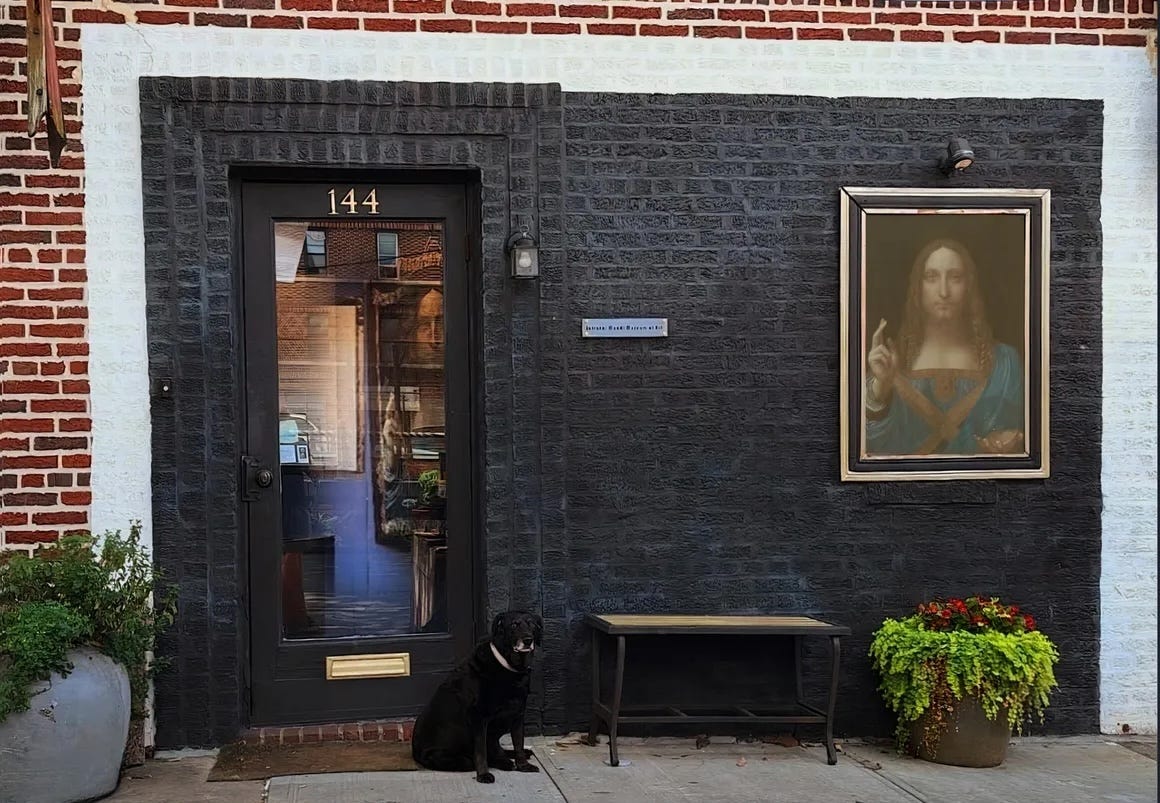
Salvator Mundi Museum of Art
⬤ 144 Union Street
I discovered the Salvator Mundi Museum of Art because it’s next door to my favorite restaurant, Petite Crevette. Nestled on the western edge of what could plausibly be called Carroll Gardens, on a small street above the BQE, “Brooklyn’s oldest and most loved seafood bistro” is enough reason to make the trip—eccentric interior, endearing proprietor, and chef’s-kiss grilled fish. But in the adjacent storefront, behold: a reproduction of one of the world’s most famous paintings, encapsulated within a 45-square-foot museum behind a pane of glass.
The revolving exhibitions inside relate in various ways to the Salvator Mundi, the painting of Christ attributed to Leonardo da Vinci ca. 1500, famous for its rediscovery, contested attribution, and record-shattering $450 million sale at Christie’s in 2017. In response to the historic events, in 2017 the artist Elliott Arkin opened this micro-museum. As of January 2026, the museum was showing The Art of Rescue, whose curatorial aim was to pair “stories of great art recoveries”— a Renoir discovered in a flea market, a resurfaced Fabergé egg that eventually sold for $30 million—alongside “portraits of adoptable dogs from Badass Animal Rescue.”
(Should you desire to support this work, on the SMMoA website you can purchase a Salvadog Mundi™ canine pullover that promises to make your dog “look like a million bucks. Wait,....change that.....now your pooch can look like 450 million bucks in the brand new Real Salvator Mundi doggie ribbed tank top. Don’t miss this opportunity to be the envy of every bitch on the block.”)
And in The Drift I mentioned…
“The History of English”
⬤ Podcast
This underappreciated series, hosted by attorney and autodidactic linguist Kevin Stroud, begins 6,500 years ago, when the Proto-Indo-European language group started to fracture. From there, he builds a word-by-word etymological epic that turns into a stealth history of the entire world. It’s deadpan, meticulous, and blissfully unproduced; eleven years in, Stroud is nearing two hundred episodes and only in the 1600s, with four hundred years to go. The questions may seem elementary (why does knife have a silent k?), but the answers are invariably thrilling, as with the origin of tartar sauce (a thirteenth-century British slur about Tartars being warriors from hell).
Subscribe to
The Common Table, a foodcentric mag + newsletter from Studio Lovell that is consistently great. Seeds, soils, lust.
Read and admire
The Hill. Hermione Hoby and James Wood and Rachel Aviv can tell you why. I will just say how moved I have been by Harriet Clark’s book and her whole thing. A testament to writing the project that chooses you even if it takes you two decades. Most of us will not arrive at the end of our Sisyphean Journey with a masterpiece, but we have to carry on (engaged; affianced) as if we will. Just, you know, commit.
At first read, it might sound like Iris Murdoch is saying the opposite when she writes: “Writing is like getting married. One should never commit oneself until one is amazed at one’s luck.” AND YET the idea is still that you have to propose before you commit. You propose to the first draft. Then you wait to see if you feel amazed at your luck.
Rich words. Off to Venice next month and will look out for signs of new beginnings, while listening the history of words. Thanks
I have been so curious about The Hill!!