

My book has a cover! Can you believe it:
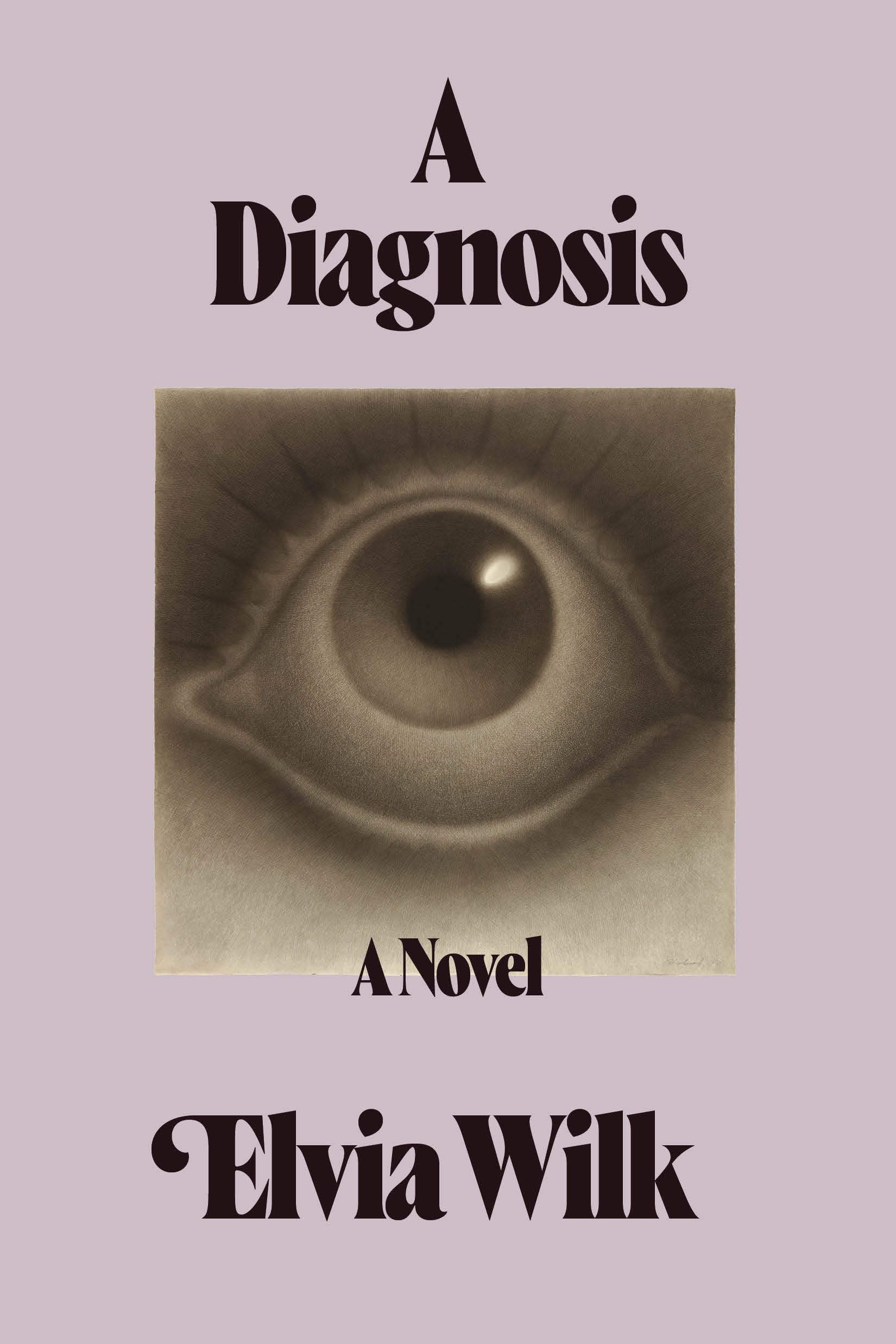
The eye is by ocular genius Rodolfo Abularach. The design is by book genius Michael Salu. With enormous thanks to Michael and everyone at Graywolf and my agent Claudia and the Abularach estate for manifesting the dream. 👁 February!
Nighttime Logic
I hate the morning. That’s half the premise of my book. But as an experiment, a year ago I started writing in the early mornings before I’m quite awake. Then, once the daytime has taken over, I try to see what I was doing and to impose some structure… to bring the thing into the light without overexposing it.
The whole time I have been thinking about Kelly Link’s concept of Nighttime Logic. The idea is that there is a kind of story logic that adheres neither to the sense-making of waking life nor the surreality of dream life, but produces meaning in a different way. It’s not irrational or unreal, but it’s not on the surface level of reality. Something else is ticking the clock of the story. It lives somewhere between the indeterminacy of the dream space and the overdeterminacy of waking life. This seems like how Mark Fisher describes the Eerie: as a disjuncture between cause and effect, where the events are related, but we aren’t sure exactly how.
Kevin Brockmeier did an interview with Kelly Link about this that should be taped on everyone’s wall, especially if you’re not exactly working in consensus reality. Brockmeier formulates the differences between Daytime Logic, Nighttime Logic, and Dream Logic this way:
A narrative possesses daytime logic when at the end you can say, “This happened, and then this happened, and it makes sense, and I can explain why.” With nighttime logic, you say, “This happened, and then this happened, and it makes sense, and I can’t explain why.” And with dream logic, you say, “This happened, and then this happened, and it doesn’t make any sense.”
In other words, daytime logic produces a logical, causal kind of sense, while nighttime logic produces a more mysterious, emotional kind of sense. Dream logic produces emotion but not sense.
This is such a good way of thinking about the internal engines of a story outside the framework of genre (which has really dead-ended… who cares whether you have spaceships except the Amazon algorithm). If the driver of the sequence of events is not exactly reason, the correlation is happening, probably, on an associative level, through image, motif, rhyme, sounds…
Melissa Lozada-Oliva gives examples of the three logics in a course description for a class that I would have loved to take:
In daytime logic, a creepy house is creepy because someone died there, and perhaps you feel their ghost—the logic is linear; what you are presented with is what you get. In dream logic, a house has walls made of spaghetti and people with dolphin heads—things don’t make sense. By contrast, nighttime logic fills us with a greater sense of unease. You arrive at a house, and it’s filled with normal people. They’re alive, and they all seem to know you—the only problem? You don’t know them. Reality becomes unmoored.
Most of my fiction is Logically Nighttime. What I’m curious about is how to write nonfiction that way. Can you get things to cohere without the premise that everything is made up? So far, unclear. Most of the writing I’ve brought to my writing group this year has been a mystery to me. My questions for them are mostly: What IS this?
I’ve been “producing” at a fast clip; it’s almost effortless to write and almost impossible to fix. It seems to (happily) negate its own editing. (Is this just… journaling??) I’m a finisher, so this long period of generating without packaging is weird.
When we were talking about our different “processes” last week, my friend, who writes brilliant books from start to finish with no slop and no runoff, called her method the “Steamroller” (actually she said Dampfwalze and we had to figure out the translation). I couldn’t name my method, because there is no method. If pressed, I would say my method is opening my perfect notebook or a Word doc and asking how many normal rules of writing I can break in a day.
Under cover of darkness you can get away with anything. Then when you look at what you made in the light, it disintegrates at the edges. If you try to blast it with fluorescents, it loses its character entirely. How to keep it intact, while making it legible enough to make sense to someone else? Iris Murdoch says:
“Any artist knows that the space between the stage where the work is too unformed to have committed itself and the stage where it is too late to improve it can be as thin as a needle. Genius perhaps consists in opening out this needle-like area until it covers almost the whole of the working time.”
It would be good to be a genius, but since not, I am trying to open up that needle-like area with a crowbar. If you have any ideas for what tools to use, please comment.
How German is it
My 100-year-old great aunt gave me this book last week and so far I’m loving it:

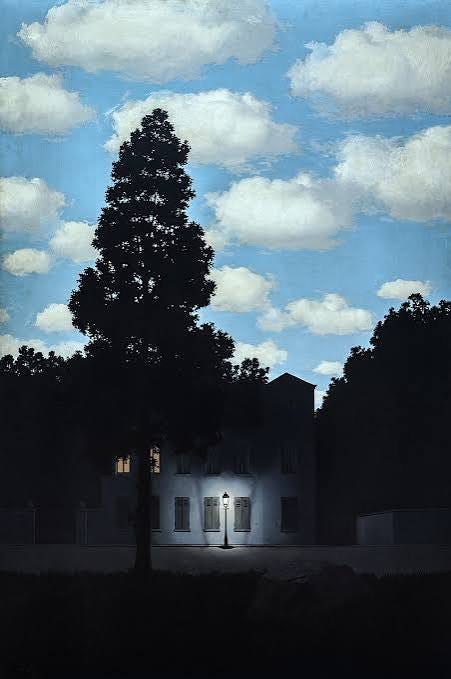
AND — Magritte
My aunt and I discovered that we have both been reading John Berger! The NYRB reissues coming out right now are ace.
Berger’s essay on Magritte from About Looking contains a perfect description of Nighttime Logic. Who could be more Nighttime than Magritte? I read it at around four in the morning and found my notes the next day indecipherable, but I had pencilled all over this passage:
To conceive of the impossible is difficult. Magritte knew this. “In both the ordinary and extraordinary moments of life, our thought does not manifest its freedom to its fullest extent. It is unceasingly threatened or involved in what happens to us. It coincides with a thousand and one things which restrict it. This coincidence is almost permanent.” Almost, but the experience of escaping from it occurs spontaneously and briefly some time or another in most lives.
[…] This is why very many can recognize in Magritte a part of themselves which otherwise has no place in the present; the part which cannot concur with the rest of their lives.”
A suggestion for Nighttime
I’m not allowed to go on YouTube because, of all the internet temptations, it is the most sacred and most dangerous. YouTube is where hours vanish into the night.
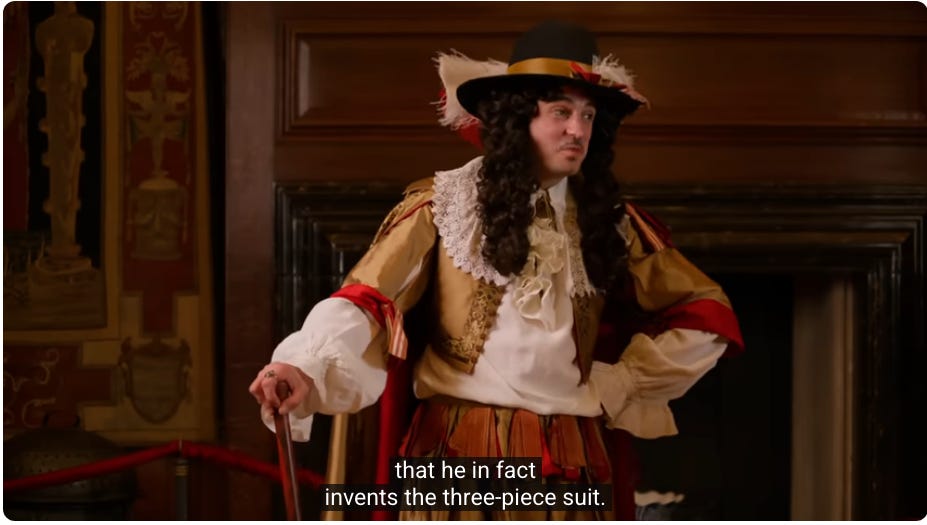
But if I were to go on YouTube, I would watch all of the Get Ready With Me videos from the Historic Royal Palaces account, which is made by the palace’s professional historic interpreters, and I would pay special attention to the Henry VIII kitchen staff menswear and the “bum roll” of a Seventeenth-Century Queen.
P.S.
The CLOCK gene
I haven’t spent enough time hyping this acronym. The CLOCK gene is the biological basis for setting the circadian rhythm in tens of thousands of organisms. It was discovered in 1994 by Dr. Joseph Takahashi, who decided to call it:
Circadian
Locomotor
Output
Cycles
Kaput.
I wonder what that naming session was like in the lab. In retrospect, I could have used Circadian Kaput as the title of my book.
The tool I've found is retyping. Not editing the night draft but copying it out into a fresh document, line by line, letting whatever wants to shift shift on the way through. Editing puts you outside the thing with the fluorescents on. Retyping keeps you inside it, so the fixes arrive as part of the sentence instead of as verdicts on it. Slow crowbar, but it doesn't leave marks.
Wow yes — I never would have thought of this! It’s also nice because it helps frame the scientific method as a constant movement toward day rather than an arrival at an endpoint or conclusion. And starting with a question or suspicion rather than answer. (Is the job of writing nighttime then to stay in or preserve the obscure state rather than moving out of it? Does it have a job, idk)