

Last month I was gone from the internet for what everyone can agree are good reasons: writing a lot and going to Japan.
I peaked in Japan… I cried three times: twice from beauty and once from eating food. There was also feeding monkeys, petting and getting sort of attacked by deer, the house museum of ceramicist Kawai Kanjiro, the temple with over 100 species of moss, the omakase chef who got drunk enough to start using his knife as a sword. I sat in the jazz kissas and I ate a new grape-flavored chewy thing or icy snack ever day…
Major moment was seeing the Reversible Destiny Lofts Mitaka, since my lifelong dream has been to see this Arakawa and Gins apartment building that makes your body evolve in a new direction, possibly backwards, possibly forever into immortality. This trip was my/our two-year belated honeymoon so traveling to a place where I and husband can begin to age backwards together was very important.

I’m just going to treat this blog like a whatsapp message for a minute…
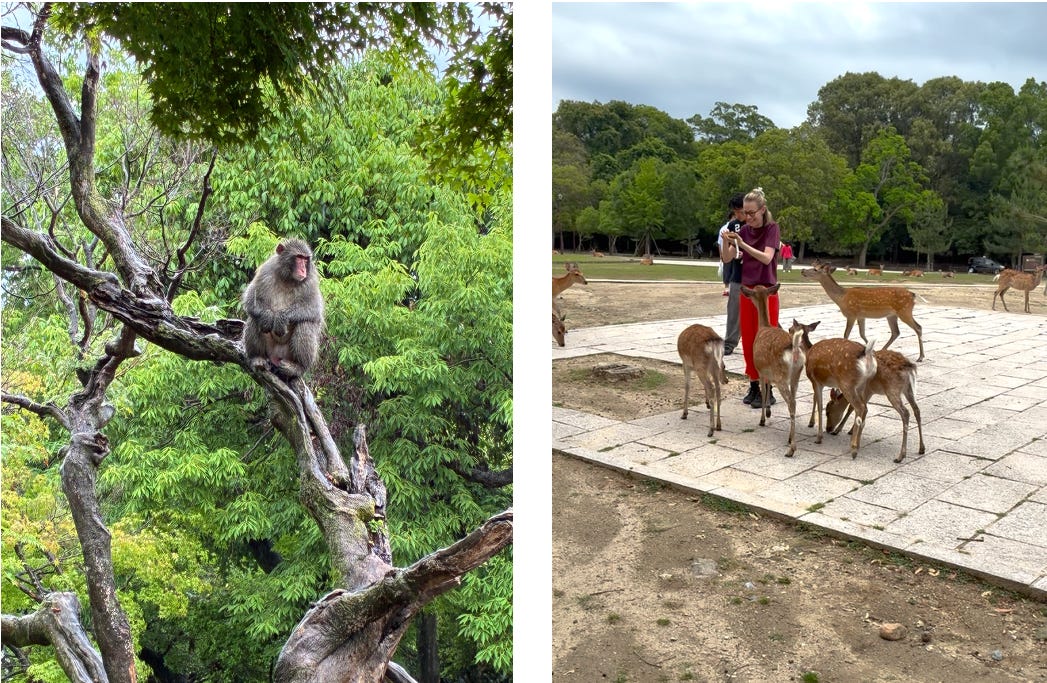
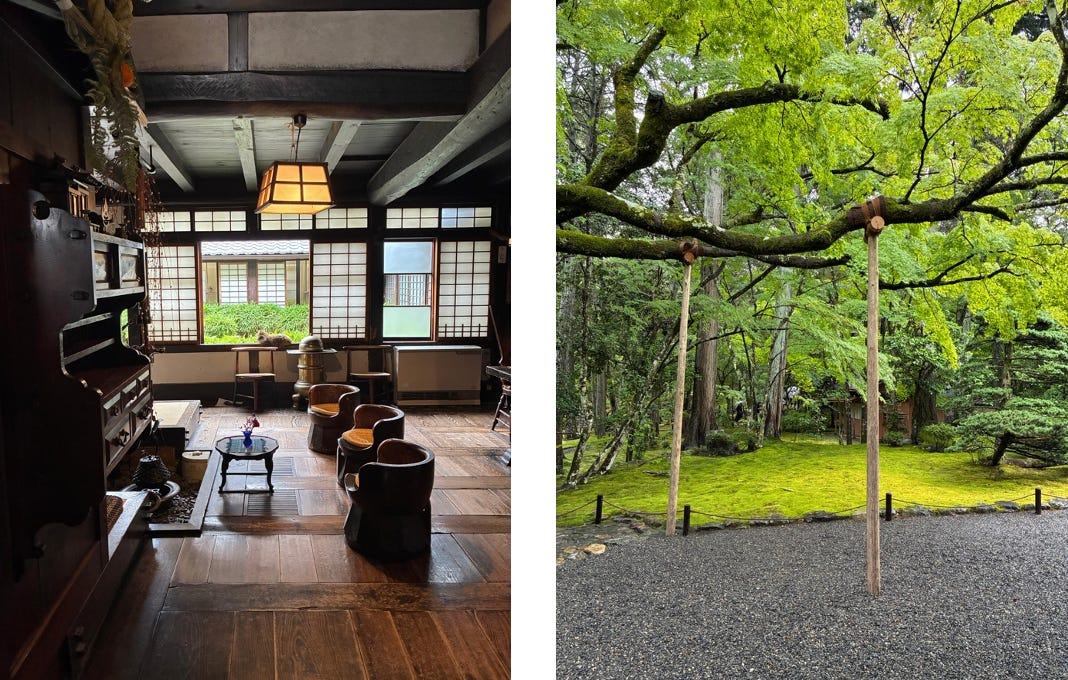
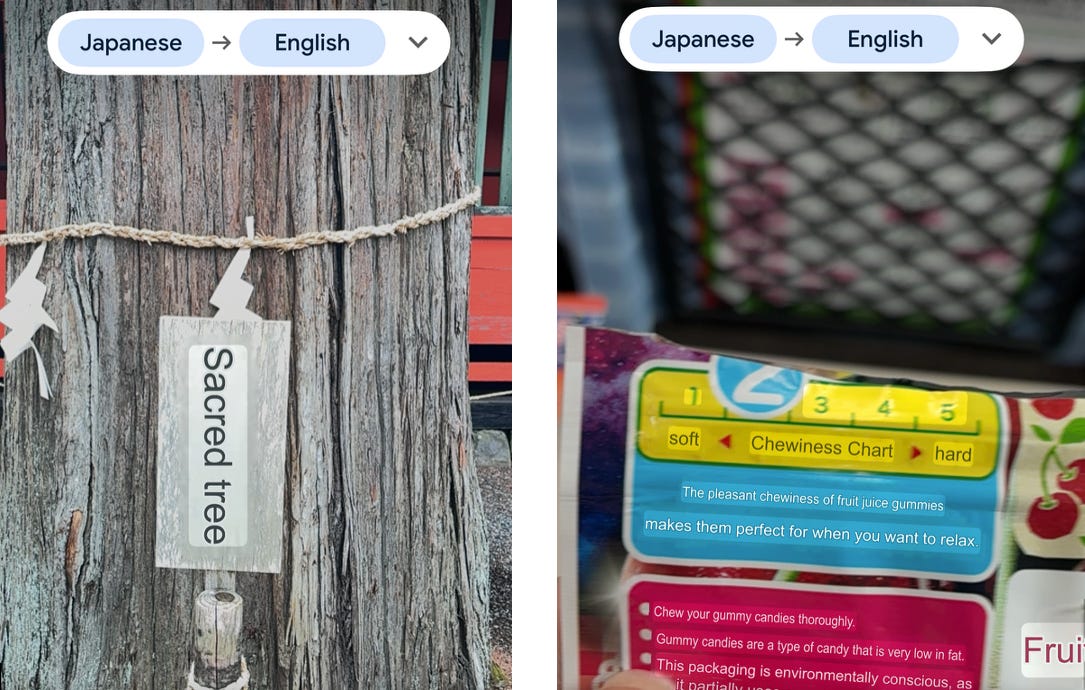

As you know I hoard recommendations so if you are ever going to Japan, Boyyyyyy do I have the Google Map for you. Even given the use of server space I think that collecting lists of restaurants and architectural marvels is superior than collecting objects, except art by your friends and certain types of shoes, which brings me to this rec for those who are not in Japan but are within subway distance of the New York Historical Society, which just opened….
The Weitzman Museum of Shoes

Big news, I finally wrote on Sleep Dealer
I’ve been trying to write about this 2008 cyberpunk movie by the director Alex Rivera for over a year and I finally gathered myself and my enthusiasm together and my long essay just came out in e-flux journal. This movie HAS EVERYTHING!! that matters to me. Sleep and work and time and borderlands and VR sex and waterways… the 24/7 economy, the obliteration of circadian rhythms, dreaming, and the future-past… Reversible Destiny, if you will. I got to bring in Jonathan Crary, Haytham El Wardany, Karen Russell, Lee Scrivner, Joshua Clover, and my other favorite nonsleeping writers.1 First part here:
Against the Clock:
Remote Work, Stolen Sleep,
and the Limits of Extraction
The human circadian rhythm is both defined by biology and dependent on context. From a series of popular cave studies, where subjects were placed in experimental conditions of total darkness and isolation, we know that the body has an innate rhythm. Biologists have identified its genetic basis in a gene called the CLOCK gene (Circadian Locomotor Output Cycles Kaput). But without access to environmental cues like sunlight or social cues like an alarm clock—cues called Zeitgetbers, or “time givers”—the rhythm doesn’t sync to a twenty-four-hour day. Our circadian clocks affect most bodily processes, from digestion and metabolism to detoxification, blood pressure, and hormone fluctuation. Among all the Zeitgebers, sunlight is by far the most crucial for setting the clock. In simple terms, human health requires a regular daily pattern on local time.
Yet around the world, few are exposed to bright sunlight or total darkness. We’re not living in caves—we’re living in screen-lit bedrooms, fluorescent-lit offices, stadium-lit highways, always-lit factories; in warehouses, malls, movie theaters, and arcades. Over 80 percent of the global population is subject to some degree of light pollution at night, and 20 percent work night hours, likely missing morning sunlight. At this point a large proportion of us are living in a state that could be called permanent jet lag. When capitalist logic overrides both the body’s inclinations and the sun’s rotation, it essentially pulls the body into another time zone.
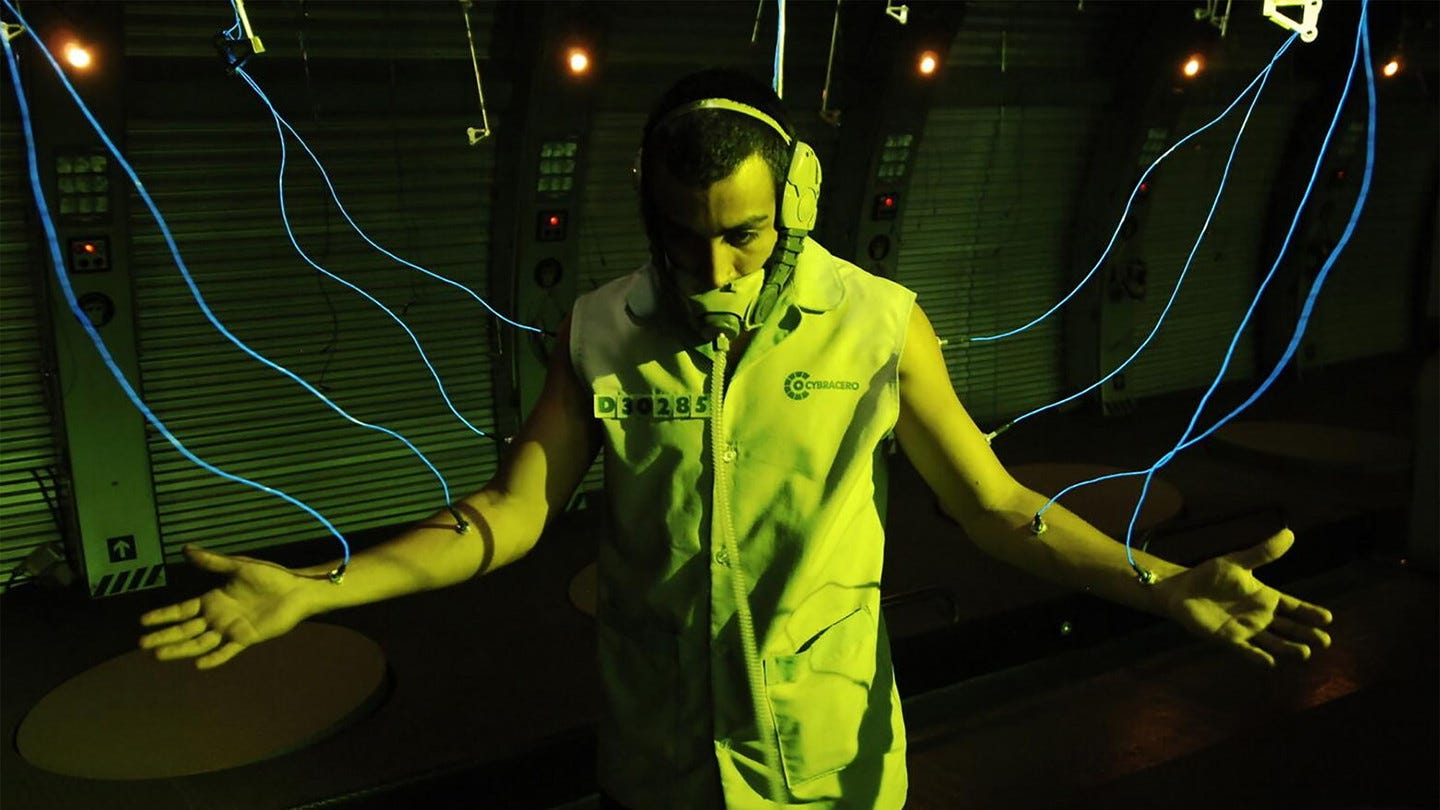
Alex Rivera’s 2008 film Sleep Dealer, a cyberpunk fable in which workers in Tijuana sell their labor hours to operate robots across a border they cannot cross, captures this sense of how working conditions create artificial time zones. Among the movie’s many other insights, which are to me startlingly and almost spookily relevant nearly twenty years after its release, is the revelation that the destruction of circadian time is the logical end point and the goal of extractive capitalism.
By now Sleep Dealer is a classic—if it’s a cult classic, its cults are plentiful. I’ve heard about it from sci-fi aficionados, labor historians, contemporary artists, and plenty of insomniacs. Rivera’s handling of technological novelty and his aesthetic choices make it a natural touchstone; it’s also solid entertainment with a clever script and satisfying plot. But what strikes me most is the way the movie portrays disjunctures in time. The way time feels is, I think, one of the hardest things to express. As a capsule of its historical context, as a work of genre fiction, and as part of Rivera’s ongoing body of work, Sleep Dealer shows what happens when the 24/7 economy treats the body clock as an inconvenience to be overcome—and what it might mean, in turn, to overcome the 24/7 economy.
Point and Click
Between 1942 and 1964, the Mexican Farm Labor Program brought four and a half million migrant workers from Mexico to the United States on short-term contracts. The plan, known as the Bracero Program, was established to address wartime labor shortages in agriculture while withholding long-term legal status and protections from the labor force. In Spanish, “bracero” roughly means “one who works with their arms”—essentially a manual laborer.
In 1997, the Peruvian director Alex Rivera released a short film called Why Cybraceros? that sardonically proposed a contemporary reintroduction of the Bracero Program, but this time: “Only the labor of Mexicans will cross the border. Mexican workers will no longer have to.” In this speculative scenario, remote workers in Mexico control versatile robots called “cybraceros,” which carry out many kinds of labor—from harvesting crops to building skyscrapers—on US soil.
The film includes footage of 1940s advertisements made by the California Growers Association, over which an authoritative voice explains: “‘Cybracero’ means a worker who poses no threat of becoming a citizen. And that means quality products at low financial and social costs to you, the American consumer.” In one scene, a man sits before a screen showing a live-streamed orange grove and maneuvers a plastic joystick that controls a robotic arm thousands of miles away. “To the worker,” the narrator says, “it’s as simple as point and click to pick.”
In his 1964 book about the mid-century bracero, the academic and labor organizer Ernesto Galarza asked, “Is this indentured alien—an almost perfect model of the economic man, an ‘input factor’ stripped of the political and social attributes that liberal democracy likes to ascribe to all human beings ideally—is this bracero the prototype of the production man of the future?” Rivera takes up Galarza’s question, and answers in the affirmative. He provides an updated prototype of this “production man of the future” even further stripped of those political and social attributes than the bracero was.
The transition from imported manual laborer to the remote virtual laborer that Rivera’s project hinges on shows just how profoundly those attributes depend on territorially defined citizenship. And, as with any flimsy territorial contingency, the geographically inscribed borderland is both the limit and the testing ground for the erosion of those attributes everywhere. As Rivera said in a 2016 interview,
The future of what’s going to happen, the reality we’re all going to live in, the surveillance we’ll all live under, the way we’ll be treated legally, or the rights we’ll have, those are all first tested on the border. The surveillance technologies, the new ways of legally justifying search-and-seizure, the entire concept of rights is first … torn apart in the borderlands.
Decades later, the updated version of Galarza’s “input factor” easily describes millions of remote workers around the world, from a chat “bot” that pops up at the bottom of a retail site to an “AI” transcription service, which are totally or partly controlled by human workers. Amazon’s unironically named Mechanical Turks are the best-known epitome of the lie of an automated machine with a person inside—except the Amazon worker is not inside the machine, as the eighteenth-century chess-playing automaton was, but elsewhere. Outsourced and displaced.
Despite the alleged split between manual and remote labor, remote workers have always also been manual laborers. Every virtual task is performed by a person with a nervous system, a threshold for pain and exhaustion, a circadian rhythm. There is no such thing as disembodied work, only work that is harder to see. From another vantage, anyone using the internet could be considered a remote worker, an input factor subjected to tasks as the basic price of entry, completing CAPTCHAs, uploading photos, or generating data through targeted ads. The invisibilization of the remotely working person only serves to uphold a fantasy that human “resources” are not being exploited (just as “the cloud” is hardly ephemeral or placeless but a conglomeration of server farms that today consume the energy equivalent of a nation the size of Japan.) And yet, the cultural narrative continues: “To the worker it’s as simple as point and click to pick.”
Sleep Dealer
Rivera expanded the concept of the cybracero from a sketch to a ninety-minute feature in his 2008 Sleep Dealer. The movie’s protagonist, Memo Cruz, lives with his family of subsistence farmers on a milpa—a field where corn and beans symbiotically depend on each other to grow—in the Oaxacan municipality of Santa Ana del Rio in Mexico. The region’s formerly free-flowing river has been dammed up by the multinational Del Rio Water Inc., which now controls the water supply, and the area is in perpetual artificial drought. Locals feed dollar bills into an ATM-like machine to retrieve meager bucketfuls.
Memo’s father reminisces about a time before the dam and its armed patrols. In an early scene, he hurls a single stone at the lens of a surveillance camera perched atop the massive dam, in a recognizable gesture of resistance in the face of hyperbolically asymmetrical power. Yet Memo imagines an exciting high-tech urban life and longs to migrate north.
True to genre, Memo is a hacker. He has rigged up a pirate radio station in a shack near his home, where he intercepts transmissions from US army command in San Diego. But the army flags his eavesdropping, locates his coordinates, and, citing his proximity to the contested dam, designates him a “water terrorist.” In San Diego, a rookie drone pilot named Rudy Ramirez is assigned his first mission: to target Memo’s home in Santa Ana Del Rio. From a booth that resembles an arcade-style shooter game, Rudy steers a drone to Memo’s house, where it detonates and kills Memo’s father.
Riddled with guilt and desperate to support his family, Memo leaves for Tijuana, “the city of the future.” There he plans to find work in one of the many job sites known as “sleep dealers”: warehouses for workers remotely operating cybraceros across the border. But first he needs to find a “coyotek” to implant his arms and neck with “nodes”—which resemble ports for speaker jacks—in order to wire himself into the online system, a kind of hyper-immersive virtual reality. People implant nodes for all sorts of reasons—sports, sex, partying, gambling—but their underlying economic function is to enable work. Memo’s earlier fantasy of the urban playground full of opportunity belies a new level of exploitation.
Conveniently, Memo meets a love interest (Luz) on the bus to Tijuana who has nodes and knows how to install them. She brings him to a back-alley bar with the requisite equipment, and while she shoots a node into his flesh, she explains: “It’s a two-way connection. Sometimes you control the machine. Sometimes it controls you.” She means this literally, in the sense that there’s a feedback loop between the user and the machine, but she’s also describing the entrapment of indentured labor that Memo is about to enter into……..
……….KEEP GOING THERE’S WAY MORE
If you know how to find Alex Rivera email him for me?
chewiness chart!!!
I’ve always wanted to visit Japan! I’m glad you had a good experience there. Looking forward to reading your piece in e-flux. I just realized I’d heard of this movie in passing and thought I’d fever dreamed it until reading your post now. I have to watch it, it’s exactly the sort of thing I’d assign to my students.